![[the "rev" stands for revolution.]](https://substackcdn.com/image/fetch/$s_!YDEu!,w_120,h_120,c_fill,f_webp,q_auto:good,fl_progressive:steep/https%3A%2F%2Fsubstack-post-media.s3.amazonaws.com%2Fpublic%2Fimages%2F19de1043-721c-42a6-9a31-1f20f5d9b0a6_976x976.png)
![[the "rev" stands for revolution.]](https://substackcdn.com/image/fetch/$s_!l189!,e_trim:10:white/e_trim:10:transparent/h_72,c_limit,f_auto,q_auto:good,fl_progressive:steep/https%3A%2F%2Fsubstack-post-media.s3.amazonaws.com%2Fpublic%2Fimages%2F7e16c521-1fc7-48e7-ab3e-58af9f9972e4_2370x494.png)
Rest for a while…
Sermon for July 21, 2024, written for Lakewood Presbyterian Church

Psalm 23
23:1 The LORD is my shepherd; I shall not want. 23:2 He makes me lie down in green pastures; he leads me beside still waters; 23:3 he restores my soul. He leads me in right paths for his name's sake. 23:4 Even though I walk through the darkest valley, I fear no evil, for you are with me; your rod and your staff, they comfort me. 23:5 You prepare a table before me in the presence of my enemies; you anoint my head with oil; my cup overflows. 23:6 Surely goodness and mercy shall follow me all the days of my life, and I shall dwell in the house of the LORD my whole life long.
Mark 6:30-56
The apostles returned to Jesus and told him everything they had done and taught. Many people were coming and going, so there was no time to eat. He said to the apostles, “Come by yourselves to a secluded place and rest for a while.” They departed in a boat by themselves for a deserted place.
Many people saw them leaving and recognized them, so they ran ahead from all the cities and arrived before them. When Jesus arrived and saw a large crowd, he had compassion on them because they were like sheep without a shepherd. Then he began to teach them many things.
Late in the day, his disciples came to him and said, “This is an isolated place, and it’s already late in the day. Send them away so that they can go to the surrounding countryside and villages and buy something to eat for themselves.”
He replied, “You give them something to eat.”
But they said to him, “Should we go off and buy bread worth almost eight months’ pay and give it to them to eat?”
He said to them, “How much bread do you have? Take a look.”
After checking, they said, “Five loaves of bread and two fish.”
He directed the disciples to seat all the people in groups as though they were having a banquet on the green grass. They sat down in groups of hundreds and fifties. He took the five loaves and the two fish, looked up to heaven, blessed them, broke the loaves into pieces, and gave them to his disciples to set before the people. He also divided the two fish among them all. Everyone ate until they were full. They filled twelve baskets with the leftover pieces of bread and fish. About five thousand had eaten.
Right then, Jesus made his disciples get into a boat and go ahead to the other side of the lake, toward Bethsaida, while he dismissed the crowd. After saying good-bye to them, Jesus went up onto a mountain to pray. Evening came and the boat was in the middle of the lake, but he was alone on the land. He saw his disciples struggling. They were trying to row forward, but the wind was blowing against them. Very early in the morning, he came to them, walking on the lake. He intended to pass by them. When they saw him walking on the lake, they thought he was a ghost and they screamed. Seeing him was terrifying to all of them. Just then he spoke to them, “Be encouraged! It’s me. Don’t be afraid.” He got into the boat, and the wind settled down. His disciples were so baffled they were beside themselves. That’s because they hadn’t understood about the loaves. Their minds had been closed so that they resisted God’s ways.
When Jesus and his disciples had crossed the lake, they landed at Gennesaret, anchored the boat, and came ashore. People immediately recognized Jesus and ran around that whole region bringing sick people on their mats to wherever they heard he was. Wherever he went—villages, cities, or farming communities—they would place the sick in the marketplaces and beg him to allow them to touch even the hem of his clothing. Everyone who touched him was healed.
God, who is our Parent, remind us each day that you yearn for us to rest. That you have created a world in which relaxation is sacred. May we rest for a while in your words. And as we listen to your Word today, whatever builds up, may we remember. Whatever tears down, may we forget. Amen.
—
[This sermon was my last with the beloveds at Lakewood Presbyterian Church as I finished my supply pastoral position with them during their pastor’s maternity leave. May we all remind ourselves that rest is resistance.]
Well, beloveds, it’s my last Sunday with you! I’ll still be working through the week, but I can’t say how much I have loved working here with you over the summer. I am so hopeful about what you are doing in the world and what you have to offer the Lakewood community. You feel like a family as church, and you have welcomed me into that family with open arms.
Today the Scripture we have before us led me to consider the idea of rest for us all this morning—we know this concept through the religious practice of Sabbath—today I want to remind us all how rest is supposed to be an important call on our lives; how rest is counter-cultural, meaning you have to look outside of culture to find examples of genuine rest; and I want to briefly touch on how you just had a leadership rest—where one leader was out and another subbed in—and how this leadership rest was an example of sacred rest.
Rest is important.
It’s been an interesting thing being here with you over the summer months—I’ve heard from you often how your summer rhythms change the rhythms of the church and how you pack your schedules with new and vibrant things over the summer season. So many weeks during the Prayers of the People, we prayed for people’s travel plans. Your summers are busy and full, and dare I say—not restful. We still need to learn rest in our society.
The Psalm for today is a very famous Psalm. It describes a Protector God and is often read at funerals and memorial services because of its emphasis on the peaceful, prepared protection of God. For today’s context, I am amazed to see the themes of rest and relaxation that I never saw before in this Psalm—God is described as making the narrator lie down in green pasture, beside still waters, restoring one’s soul—to me, this sounds like a relaxation hike on a day off! Or that the writer of this Psalm is describing a weekend getaway outdoors! So often I have viewed this Psalm as a balm for the suffering, as a witness to the resurrection, as a testament to God’s presence in our hardships—but today I’m seeing it with a new lens, as God wishing for us to have rest, even in our ordinary days. And I see it even as God saying that the medicine for hardship can be rest. Maybe God is saying, when we suffer, when we experience hardship, may we also experience rest.
The passage in Mark for today was originally a bit shorter, but I put the entire text in so that you can see the context of the stories of rest that Jesus is seeking:
Mark 6:30 begins, saying that, “Many people were coming and going, so there was no time to eat. He said to the apostles, “Come by yourselves to a secluded place and rest for a while.” They departed in a boat by themselves for a deserted place.
But then the text goes on to say that people saw them leave and followed them, and Jesus had understanding for their suffering, seeing they were “like sheep without a shepherd,” so he began to teach them.
The text continues: Late in the day, his disciples came to Jesus and said to Jesus, “This is an isolated place, and it’s already late in the day. Send [these people] away so that they can go to the surrounding countryside and villages and buy something to eat for themselves.” But Jesus tells them, “You give them something to eat.”
And then we get the story of Jesus feeding the 5000…
Right after that, the text continues: Right then, Jesus made his disciples get into a boat and go ahead to the other side of the lake, toward Bethsaida, while he dismissed the crowd. After saying good-bye to them, Jesus went up onto a mountain to pray. Evening came and the boat was in the middle of the lake, but he was alone on the land. He saw his disciples struggling.
So Jesus sees them, they’re trying to row one way and the wind is blowing against them (facepalm) and so he WALKS ON WATER to get to them. They think he’s a ghost; he says, don’t worry it’s your buddy Jesus! And when he gets on the boat the wind settles down.
The story continues: When Jesus and his disciples had crossed the lake, they landed at Gennesaret, anchored the boat, and came ashore. People immediately recognized Jesus and ran around that whole region bringing sick people on their mats to wherever they heard he was. Wherever he went—villages, cities, or farming communities—they would place the sick in the marketplaces and beg him to allow them to touch even the hem of his clothing. Everyone who touched him was healed.
Now, when I hear these stories of continual demands on Jesus’ time all while he keeps trying to find little moments of respite, the closest thing in my life to this experience is early motherhood.
Picture this retelling of the story: “Many people were coming and going as the babies were born, so there was no time to eat. The new mother said to her partner, “Come, let’s go be by ourselves in a secluded place and rest for a while.” They departed to the backyard by themselves for a deserted place.
The baby saw them leave and cried out to them, and the mother had pity on the baby, seeing they were like sheep without a shepherd, so she began to feed them.
Late in the day, the in-laws came to the house and the partner says, “This is an isolated place, and it’s already late in the day. Send the houseguests away so that they can eat for themselves.” The mother replied, “You give them something to eat.”
(And then we get the story of the mother feeding the baby 5000 times… 🙃)
Right then, the mother told her partner to get into the car and drive the baby around in the neighborhood for a whole, toward Bethsaida, while she dismissed the house guests. After saying good-bye to them, the mother went up onto a mountain to nap. Evening came and the partner was circling in the near the house, confused where to go. She saw her partner struggling.
And then she gets up and walks on water and feeds the baby, yada yada…you get it — the demands of early motherhood and Jesus’ ministry demands are not dissimilar…
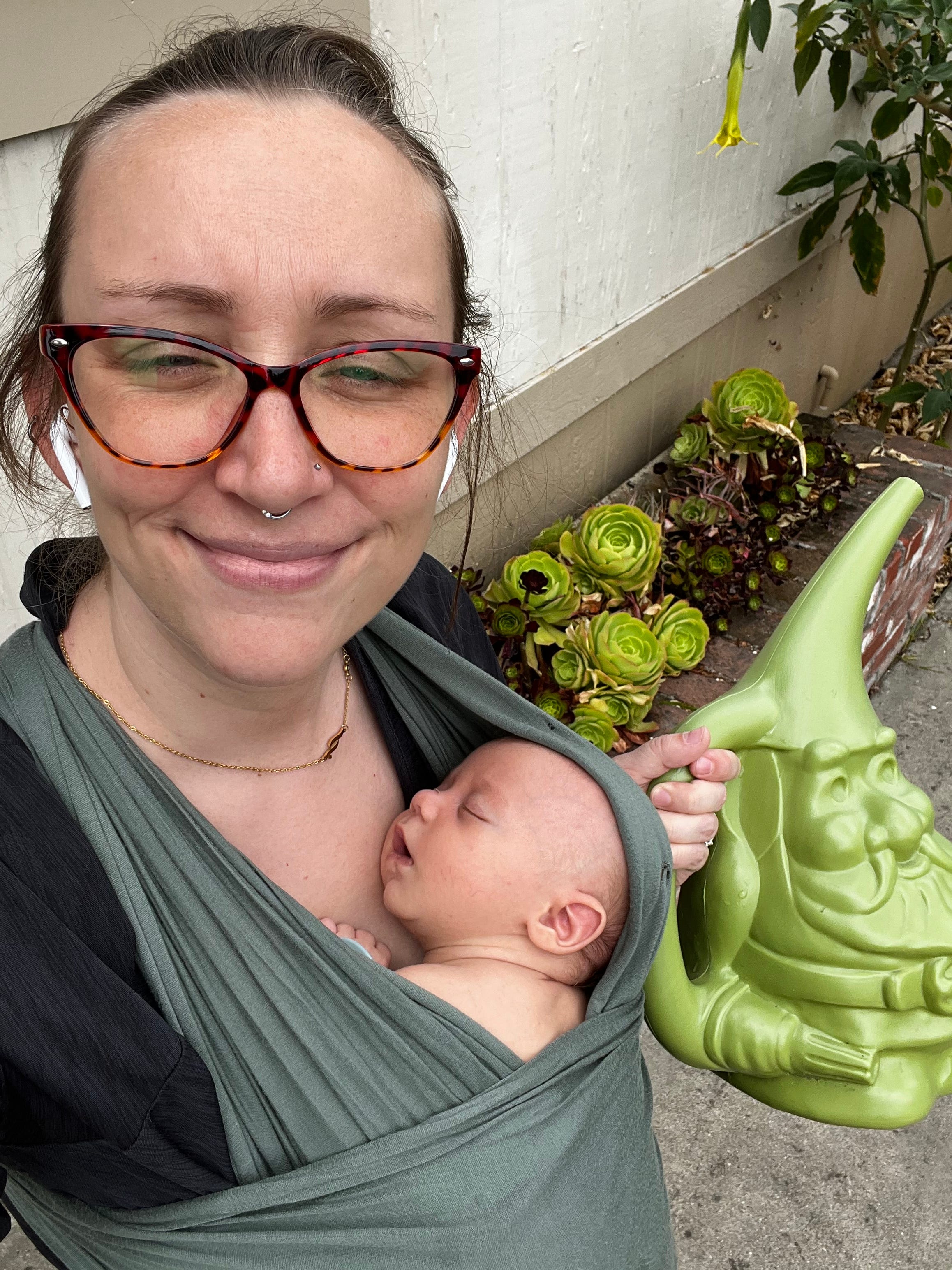
My point is twofold 1) I think you can probably look into your own history and identify a time in your life when you relate to Jesus — maybe it was new motherhood, maybe it was the first time managing people at a new job, maybe it was serving in church lay leadership or on the school board or at the VA — can you relate to a time where you were constantly trying to catch up with the needs placed on you? Where you had to take care of others and sneak in taking care of yourself? Jesus gets that! And despite the short amount of content we have on Jesus’ life, we still see that the writers of the New Testament thought it was important enough to tell us how Jesus was constantly finding time to rest. Jesus wasn’t taking off for a spa day. He was not getting a weekend off. We don’t see him taking vacation. It’s little moments of pause between the big moments—some of the biggest for our religious stories—where Jesus looks toward solitude or looks to his disciples with compassion or looks to the people who need him with understanding. Our God rests. Not for every-once-in-a-while long stints, but for frequent, carefully quieted moments. What would it look like for you to practice those short, regular restful moments in your own life?
This is a hard task! One reason it’s hard is that rest is counter-cultural to American society, so you have to look outside of culture to find genuine rest. Who do you know who models rest well to you? I’m thinking about when gymnast Simone Biles took a break from gymnastics and Naomi Osaka took a break from tennis—those women are two of the most impressive athletes in the world, and yet I find their boundaries around rest and bodily safety to be just as impressive. It was a huge risk for them to take breaks from their professional career as athletes for a multitude of reasons, and yet they did it! They decided, against the expectations of society, to rest.
I grew up believing that it was vital to work hard and excel at whatever responsibilities I had in life, and this idea in theological terms is called “the Protestant work ethic.” The idea of the Protestant work ethic emerged during the Protestant Reformation in the 16th century in Europe. It was influenced by several key figures, including Martin Luther and our very own Presbyterian-lineage leader, John Calvin, who were leaders in the movement to reform the Catholic Church. During the Reformation, Martin Luther and others were critical of what they saw as corruption and excessive wealth within the Catholic Church. As a reaction to that, they emphasized a return to simpler and more sincere religious practices based on their interpretation of the Bible. As a result of that — faith became more personal and less institutional, which led to theologians like Luther and Calvin to teach that because everyone should have a direct relationship with God, individuals (not the institution) were responsible for their own spiritual lives. This led to a belief that living a disciplined and responsible life, including working hard and being productive, was a way to honor God.
Calvin, in particular, expanded on this by emphasizing the idea of "calling" or "vocation." He believed that each person had a specific role or job in life that was given by God, and doing that job well was a way to serve God and society. The Protestant Reformation, again, as a reaction to the wealth hoarding of the 16th century Catholic Church, promoted values such as honesty, thrift, and diligence in work, so these values became intertwined with religious beliefs, encouraging people to work hard not just for material gain but also as a moral duty and a way to demonstrate their faith. We lean into these ideals heavily in the Presbyterian tradition, and so the cultural impact of these values over time (and without the context of the cultures they were responding to at the time) is such that these ideas have spread and influenced the development of Western culture and economics. Hard work, discipline, and responsibility became American values, not only important for personal success but also for the prosperity and stability of society as a whole.
Where does rest fit into this? It doesn’t! Calvin and Luther were responding to a sluggish, gluttonous institution that was gouging the resources of poor people across Europe—they weren’t focused on rest because the people in power they were responding to had plenty of rest time. But for today’s Christians in our context here in this church in Lakewood, Washington—I’d say rest needs to be a priority. This is an opportunity to do theology for our own context, like Luther and Calvin did: how might you imagine a new lens on a theology of calling and vocation that includes rest as a sacred act. How might your counter the culture of work to include a culture of pausing, of recovery, of restoration?
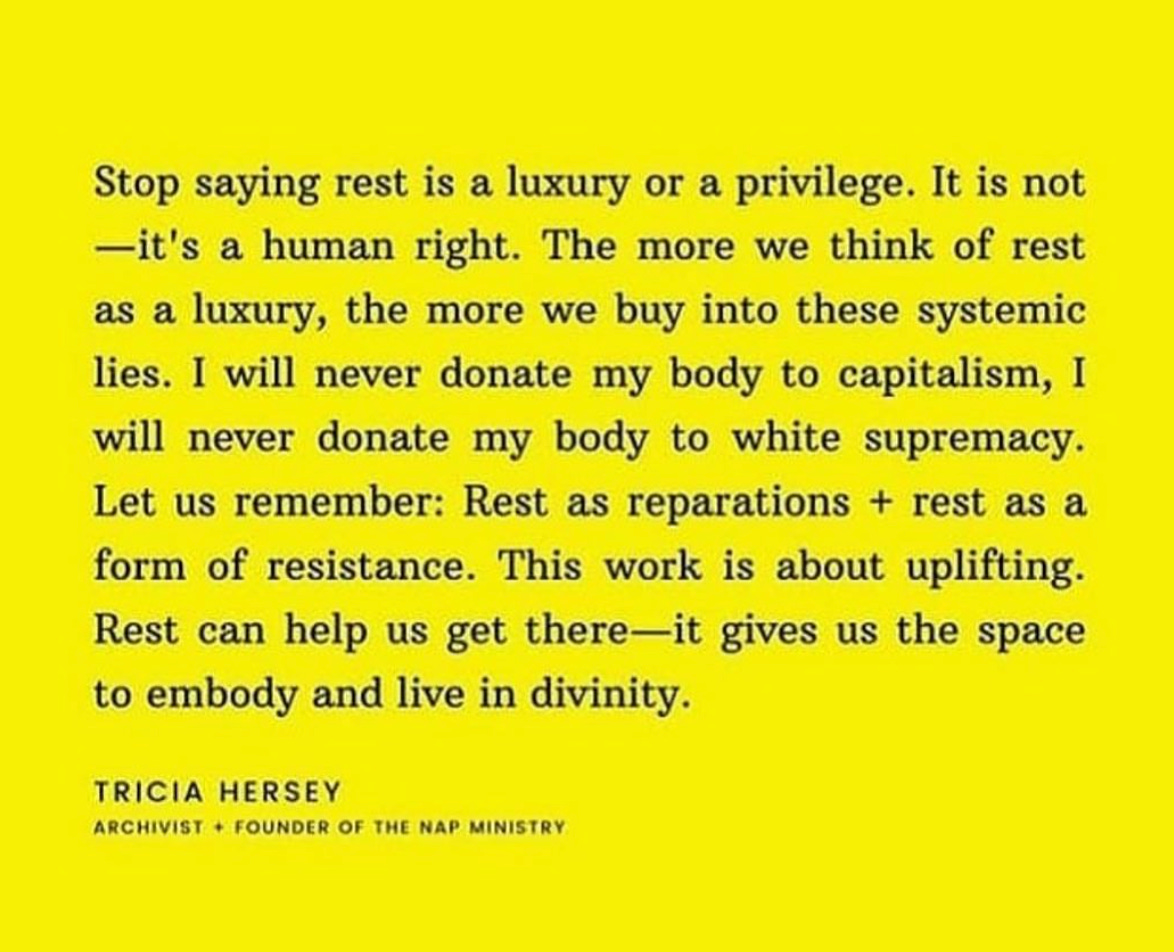
One counter-cultural offering of rest that I want to uplift is an organization called The Nap Ministry. This initiative, started by Tricia Hersey (who rightfully calls herself The Nap Bishop), challenges the societal glorification of productivity and busyness by advocating for rest as a form of resistance and healing. The Nap Ministry critiques the capitalist notion that worth is tied to productivity and encourages people, especially marginalized communities, to reclaim rest as a right rather than a privilege. The movement emphasizes the historical and cultural significance of rest, particularly within Black communities, where rest has often been denied or undervalued due to systemic inequalities. It draws from Black feminist theory, and through various platforms including social media, workshops, and performances, the Nap Ministry promotes the importance of rest as a revolutionary act. It encourages people to listen to their bodies, prioritize self-care, and challenge the oppressive structures that perpetuate exhaustion and burnout. I think Jesus would be into the Nap Ministry. I think he would take naps with them between healing gigs all the time.
“Rest is not dessert.”
I’m sure you’ve heard a lot of sermons on Sabbath keeping and the need for rest—it’s something we like to talk about as Christians but rarely live into. My new idea for you today is that perhaps the way we begin this journey of finding rest is to build in the little rests—instead of expecting only the big ones—like a new mother builds in short breaks to breath in and out, to find a wink of sleep, to wash her hair—before diving back into the work. Perhaps our rests look more like a bathroom break and less like a 9-day cruise. Perhaps our rests are more like Jesus models—woven into our daily callings instead of scheduled out every 7 years as big expensive vacation. Because we actually need to rest every day. We need breaks all the time, not as a treat at the end of the month. Rest is not dessert. It’s essential to our survival. And it’s essential to our capacity to do ministry with each other.
Tricia Hersey, the founder of the Nap Ministry, tells us:
You just had a leadership rest. It wasn’t a big vacation or a long-time-coming official sabbatical, it was a regular, necessary break from each other to keep each other thriving and energized in your relationship with each other. Pastor Laura has been away for four months, and you all have had a rest from each other — now, I’m not supposing that birthing and caring for two babies in the last four months has been restful for Pastor Laura—nope! But what I am bringing into this space this morning is that you all have had a rest from each other. And while you took a rest from Laura, you have had someone come in (me!) who was pumped and energized and had a full cup to be with you for these four months. By supporting something like parental leave for your pastor, you allowed the community to have rested and present leadership, leadership that could be available to both their personal lives and to the congregation. To me, that is living into your vocation as a church.
So, you’ve gone on vacation from your regular pastor, and you’re soon coming back home to live your normal life. What have you learned in the meantime? What will Pastor Laura have to share with you when she returns? These types of breaks and rests and interruptions of the usual flows can be so very healthy for institutions and leaders to have together. Rest/breaks/seasons of separation can birth new things into the world. I wonder how this most recent break might transform you all for the future.
As I leave you, I hope you remember: rest is an essential part of our survival. Each and every one of you deserves it, as a right, not a privilege. Jesus wove it into his ministry as a matter of fact, not as an end to a long day of work. Rest might look more like regular water breaks during the marathon than waiting to chug the entire cooler at the end of the race—don’t dehydrate yourself! God wants regular abundance for you and your church and its leaders. Look for the ways that you might integrate these practices of rest and relaxation and restoration into your everyday being. Look for ways you might encourage and support each other in your own rest. Rest is holy! Rest is ministry.
Rest is good. God is good, and God wants goodness for you.
May it be so.
Amen.