![[the "rev" stands for revolution.]](https://substackcdn.com/image/fetch/$s_!YDEu!,w_120,h_120,c_fill,f_webp,q_auto:good,fl_progressive:steep/https%3A%2F%2Fsubstack-post-media.s3.amazonaws.com%2Fpublic%2Fimages%2F19de1043-721c-42a6-9a31-1f20f5d9b0a6_976x976.png)
![[the "rev" stands for revolution.]](https://substackcdn.com/image/fetch/$s_!l189!,e_trim:10:white/e_trim:10:transparent/h_72,c_limit,f_auto,q_auto:good,fl_progressive:steep/https%3A%2F%2Fsubstack-post-media.s3.amazonaws.com%2Fpublic%2Fimages%2F7e16c521-1fc7-48e7-ab3e-58af9f9972e4_2370x494.png)
I'm rooting for you!
Sermon for June 16, 2024, written for Lakewood Presbyterian Church

Ezekiel 17:22-24
17:22 Thus says the Lord GOD: I myself will take a sprig from the lofty top of a cedar; I will set it out. I will break off a tender one from the topmost of its young twigs; I myself will plant it on a high and lofty mountain.
17:23 On the mountain height of Israel I will plant it, in order that it may produce boughs and bear fruit, and become a noble cedar. Under it every kind of bird will live; in the shade of its branches will nest winged creatures of every kind.
17:24 All the trees of the field shall know that I am the LORD. I bring low the high tree, I make high the low tree; I dry up the green tree and make the dry tree flourish. I the LORD have spoken; I will accomplish it.
Mark 4:26-34
4:26 He also said, "The kingdom of God is as if someone would scatter seed on the ground,
4:27 and would sleep and rise night and day, and the seed would sprout and grow, he does not know how. 4:28 The earth produces of itself, first the stalk, then the head, then the full grain in the head. 4:29 But when the grain is ripe, at once he goes in with his sickle, because the harvest has come." 4:30 He also said, "With what can we compare the kingdom of God, or what parable will we use for it? 4:31 It is like a mustard seed, which, when sown upon the ground, is the smallest of all the seeds on earth; 4:32 yet when it is sown it grows up and becomes the greatest of all shrubs, and puts forth large branches, so that the birds of the air can make nests in its shade." 4:33 With many such parables he spoke the word to them, as they were able to hear it; 4:34 he did not speak to them except in parables, but he explained everything in private to his disciples.
God, you are our Great Gardener. Help us see the ways you want us to grow and propagate and be witness to new things. As we listen to your Word today, whatever builds up, may we remember. Whatever tears down, may we forget. Amen.
—
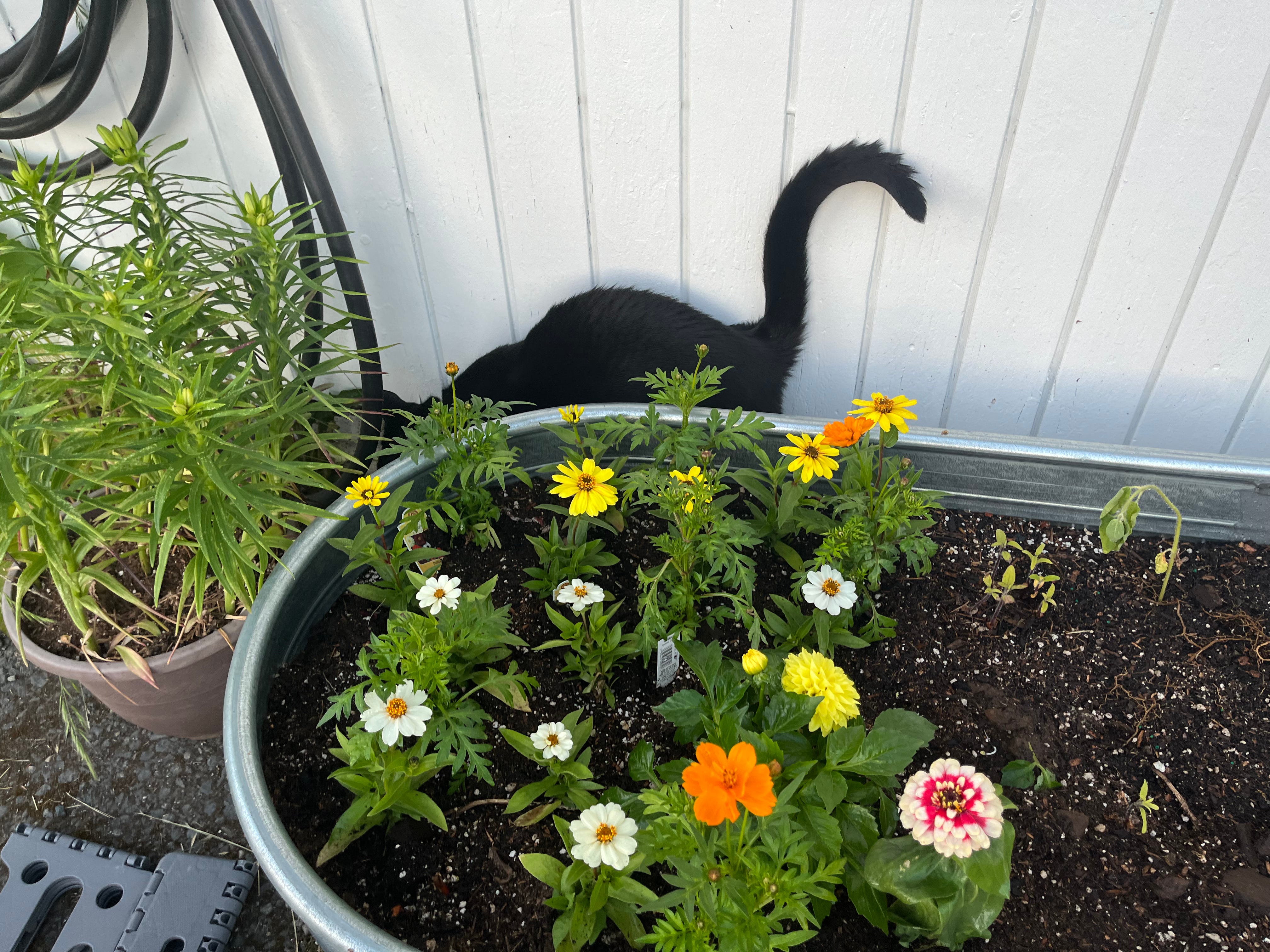
This week I worked in my garden. This was a pretty wild undertaking because Dan was gone all week to DC for work so I was struggling to maintain any sense of alertness and I’m so impressed with myself that I did anything for fun.
Because of this, I was so excited to see the plant-based Scripture we have to look through together this morning. I bring these words to you having put my hands in the soil to plant new things, in the same the spirit of growth that I’ll talk about today. I especially want to tell you that what I planted were pre-grown (so in propagation terms, divided) flowers for my bouquet garden raised beds that we have in our driveway. I have been trying for almost a year to grow a bouquet garden just from seeds, and this week I gave up on that idea, went to the plant store, and bought them, pre-grown. They had a story before they came to me, but now they will have a new life in my raised beds, where the cuttings I get from them will help them flourish and grow even more flowers, and their story will include enriching our house with fresh flowers. Keep this in mind—I didn’t start from the seed, but I still made something beautiful.
Today I mainly just want to tell you that I’m rooting for you! I believe in you! I think there are great things coming for this little church, and I want you to be ready for this place to grow like someone who just planted new plants in their garden. Gardeners know that sometimes things don’t sprout up at the time you think they will, that there is a lot of care and prep and maintenance that has to happen for things to grow, but that when you plant something, you get the gift of expectation; so let’s imagine planting some new things today. Let’s expect together.
I want to encourage you to picture yourself like a family, about to receive a new family member. You’re hosting a dinner party in the hopes that you are about to make a new friend. You’re going on a date in the hopes that you might find a new love.
In the Ezekiel passage today, we have our first plant-based story—Ezekiel is talking about propagating. Plant propagation is the process of creating new plants from a variety of sources. It's a fundamental practice in agriculture, horticulture, and gardening, and as I was thinking about it this week, I feel like it’s a great metaphor for ways that churches grow. You can propagate by divisions, tissue culture, using seeds, or using cuttings.
Division is when you divide a plant into a smaller section and ask it to grow independently — we know this deeply in the church too, especially the Presbyterian church: people break off from one church and form another. As PCUSAers, we’re the largest version of Presbyterian ilk. We have tried our best to build ourselves up as a progressive mainline denomination, not to break off again like we did as early protestants. So let’s not imagine division today for LPC.
Tissue culture is another propagation method where things are grown in labs — this is a place for crops that need cultivation that’s otherwise too difficult to achieve by conventional means…so let’s hilariously just call that seminary and say we’re not sending LPC there either today.
Seeds are like church planting—it’s literally called a “church plant.” A new worshipping community. Something completely new. We’re probably not doing that with LPC anytime soon either.
And besides, that’s not what is being described in Ezekiel.
Ezekiel tells us that God says: “I myself will take a sprig from the lofty top of a cedar; I will set it out. I will break off a tender one from the topmost of its young twigs; I myself will plant it on a high and lofty mountain.” Here God is taking a cutting, a portions of stems or roots that are cut and encouraged to root in a suitable growing medium. This is where I want us to consider LPC is. It’s a healthy plant with an opportunity to grow something new from within itself.
In theological terms, we might consider propagation through cuttings as both the transmission of and the transformation of the religious teachings of LPC, guided by their sacred origin and traditions, and hopeful at the ways they might grow in a new container or surrounded by different soil. Consider this metaphor as you imagine who you are in the next 5, 10, 15 years as a community. What are you breaking off and starting anew? How does the plant it came from inform what it will grow into? How does its positionally — the growing medium and the pot it grows in — inform how it will grow?
I’m rooting for you. In both sense of the word: I’m cheering you on. And I want to see you succeed in a new thing like I want a propagated plant to take what it came from and root into something new. I’m invested in y’all.
Today’s Mark passage tells us that the kingdom of God is like a mustard seed that grows up from the smallest seed to become the greatest shrub. I want to pull out two pieces from this: 1) “the kingdom of God,” and 2) the mustard seed.
First, let’s explore how we might interpret the kingdom of God today. Take a look at the front of the bulletin. This photo is taken from the front of Ada María Isasi-Díaz’ book Mujerista Theology, which is the prevailing work of Latina theology. In her work, Isasi-Díaz introduced the term “kin-dom” into the ecclesial lexicon. There’s an obvious reason to shift language from “kingdom” to be inclusive of leadership that doesn’t manifest as a king, meaning to be more gender expansive, but the reason Isasi-Díaz gives for taking up this term—it is to avoid “the patriarchal and elitist implications of ‘kingdom of God.’”

I don’t know if you have binged the earlier seasons of The Crown like I have, but surely we can agree: monarchies are elitist. And they’re also outdated. For us, the monarchy is barely relevant to our understanding of power in the world today, so it doesn’t exhibit anything radical to call God “king.” Isasi-Díaz is interested in a metaphor for God that describes something more akin to a family—kin. You know I love to think about language and shifts in language that help make God bigger and more abundant. All throughout Scripture we have images of God as king and God’s realm as kingdom. And this was a radical framework for the English translators working on the King James Version (KJV), to flip the script on the monarchy and attribute that earthy power to God. But today, for me at least, it loses its radical nature and verges on attributing God to a fantasy world rather than seeing God in the real, lived political experience of God’s people. My understanding of “kingship” come from Game of Thrones and an empire across the sea that I know through a Netflix show more than any real affect on my life. I have no reference for it that applies to how it was intended by the writers of the Bible, or really the first English Bible translators in King James’ England.
So, I love this alternative understanding of the wording that has become popular in preaching, especially in the national Presbyterian church, that turns kingdom into kindom—a collective of kin. Sit with that for a moment: God’s kindom. What a beautiful model for church.
This is the work I have so loved doing with you. Kinship work. As a church family, but also as a church made up of families. This church truly does kindom work. Go back to that image on the front of the bulletin. What do you see there? Who do you see there?
I see a family member. A mother. A grandma. A neighbor. A teacher. A crafter. A church member.
I see her molding something, and I just know that it’s not for herself. Like the plant cutting we hear about in Ezekiel, I know the clay she is molding was once one thing and is now being crafted into something new. And I bet it’s something she will share. It doesn’t look to me like she’s making a solitary mug to enjoy alone; she looks to be creating something big, something to be experienced, to get chipped, to be worn with use. Made to be used with kin.
This sermon is mostly (literally) flowery metaphors for change, but one really concrete and practical thing I think y’all should do to be better kin is wear name tags more. :) We’ve actually had more Sundays than not while I’ve been here that there have been new people—which is so exciting and one of the reasons I’m excited for your community to grow—but going to a dinner party where you’re the only person who doesn’t know everyone’s name is isolating. To encourage this—I got you fancy name tags! This is just a little example of a seed planted that might grow into a more hospitable welcome for newcomers here at LPC. Don’t forget to tell the world who you are.
How can we make a more kin-centered church? You are already doing it! Let’s keep propagating a place for people to grow and feel welcomed and affirmed and like kin. A place where everyone knows each other’s names, even those who are here for the first time.
Now, on the mustard seed—I've been to the Holy Land twice this year for my advocacy work and during one of my trips, I heard that mustard is actually invasive. (That’s not to say it’s not native.) It’s to say—it takes over! It spreads. And the Biblical writers of that land would have known this. So when we read about the kindom of God spreading like a mustard seed spreads, we can imagine that this means our work is to propagate something and then enjoy how fast it grows. It is not always hard work to grow things. Sometimes it just takes the right seeds, cuttings, soil, to set the scene for the goodness of the gospel to spread.
What is your good gospel at LPC that should spread like a fast-growing mustard seed?
Today is the last day for the feasibility questions (hold your applause!!) and I’m going to take the opportunity to make you do them in the sermon again :) because I think it aligns so well with this imagery of propagating new things.
The questions today are: What do you think we need most to position us for a healthy future? What is LPC excited about that makes the world a better place?
When I read these in the context of the sermon today, “What do you think we need most to position us for a healthy future?” sounds like “What pot should we propagate into? What soil do we need to thrive? What substrate should we invest in to give our roots the best chance at taking hold?”
And when I read “What is LPC excited about that makes the world a better place?” in the context of the sermon, I think it’s asking “What parts of our plant should we propagate? What looks strong enough to be taken from the original plant and root itself in a new idea? What is representative of our original plant in a way that will continue our legacy?”
As we close today, remember, I believe in you! I'm rooting for you.
Since I've come to LPC, I've just been so grateful to be here. I love this little church and I see a pathway for you to have an abundant future. I also know that you are weary! You're weary from so many transitions and, honestly, from a lot of loss. I can imagine the original plant doesn’t love to be propagated. I can imagine the original plant misses the parts that are taken to root a new thing. There are pillars of the church who are no longer here. And that is tiring to be present to. But I see great hope in you, and I see great hope in the passages for today about growing new things in God's kindom. And I also see the possibility, when you have the right seed like the mustard seed in the right environment, that growth can happen really fast, with little to do but set yourself up to reap the benefits of your growth. I expect this for you.
As we move through the rest of the liturgy today. When we say Your kindom come, Your will be done, on earth, as it is in heaven, ask yourself what do we mean? God’s family, God’s will, may be dreamed into practice here on earth, just as it is in heaven. What an abundant message of church family. To practice heaven together. I’m rooting for you as you continue to do just that.
Amen.